
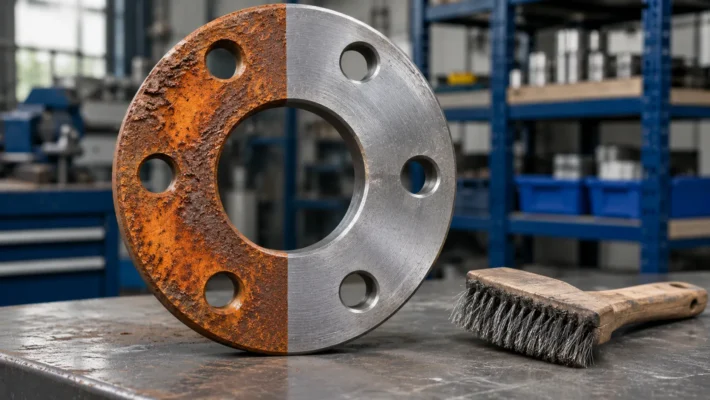
Rust appears on any iron or steel part that spends time exposed to moisture: tools, fasteners, idle machinery, structures or freshly machined parts left sitting in the warehouse. Removing it is not difficult, but doing it properly makes all the difference: if any is left behind, or if the part stays damp and unprotected, the rust comes back within a few days.
In this guide we explain how to remove rust from metal step by step: how to assess the condition of the part, which method to use in each case, how to apply a rust remover and what to do afterwards so that the rust does not reappear. These are the same criteria we follow at CH Química when formulating our rust removers for industry and maintenance.
Why metal rusts and why you need to remove all the rust
Rust is the result of iron reacting with oxygen and water. That is why it mainly affects carbon steel and cast iron, and it advances faster with high humidity, condensation, salty environments or residues of acidic products.
Unlike the layer that protects aluminium or stainless steel, iron oxide is porous and does not adhere to the metal: it retains moisture and allows corrosion to keep advancing underneath. That is why it is not enough to paint over it or to remove only the visible stain. If any residue is left, corrosion continues under the paint or oil.
How to tell what type of rust the part has
Before choosing a method, it is worth checking two things: how far the rust has spread and what metal the part is made of.
- Surface rust. A film or orange stains that come off with your finger or a cloth. It can be removed with a rust remover, without sanding.
- Scale rust. A brown crust that lifts off in flakes. First remove whatever is loose, then treat the surface with a rust remover.
- Deep corrosion. Pitting, holes or loss of material. A rust remover cleans off the rust but does not restore lost metal: if the part has a structural or safety function, you should consider replacing it.
The metal matters too. Acid rust removers act very quickly on carbon steel, but on aluminium, copper, brass or bronze it is best to choose a product that is compatible with those metals. And stainless steel needs its own treatment, as you will see below.
Methods to remove rust from metal
There are three ways to remove rust, and they are often combined.
| Method | How it works | When to use it | Drawbacks |
|---|---|---|---|
| Mechanical (wire brush, sandpaper, abrasive disc, blasting) | Removes rust by abrasion | Thick crusts and large, flat surfaces | Cannot reach corners, threads or pores; scratches the surface and also removes sound metal |
| Chemical (rust remover) | Dissolves the rust and separates it from the metal | Parts with complex shapes, fasteners, threads, hard-to-reach areas and batches of parts | You must follow the dilution and contact time, then rinse and protect the part afterwards |
| Combined | Brushing to remove loose rust and a rust remover for the rest | Scale rust | It takes two steps, but gives the best finish |
What about vinegar, lemon or bicarbonate of soda?
Home remedies work on small stains, because vinegar and lemon are weak acids and bicarbonate of soda acts as a mild abrasive. But they are slow, do not degrease, contain no corrosion inhibitors and leave the metal bare and damp, so the rust soon comes back. For maintaining machinery, tools or production parts, a formulated rust remover is faster, more controllable and leaves the surface ready to be protected.
How to remove rust from metal with a rust remover step by step
1. Protect yourself and prepare the work area
Wear chemical-resistant gloves and safety glasses, make sure there is good ventilation, and read the product’s safety data sheet beforehand. Most rust removers are acidic: do not mix them with other products and keep water to hand for rinsing.
2. Remove grease and paint
The rust remover has to come into contact with the rust. If the part has oil, cutting fluid or grease on it, degrease it first (we explain how to choose the product in types of industrial degreasers). Some rust removers, such as DESOXID L, clean, degrease and remove rust in a single operation. If the part is painted, first remove the paint with a paint stripper such as FURPINT V.
3. Remove loose rust
Use a wire brush or scraper to remove the flakes and crust that come away. There is no need to leave the metal shiny: it is enough for the product to reach the rust that remains attached.
4. Apply the rust remover
There are two ways to do this, depending on the part:
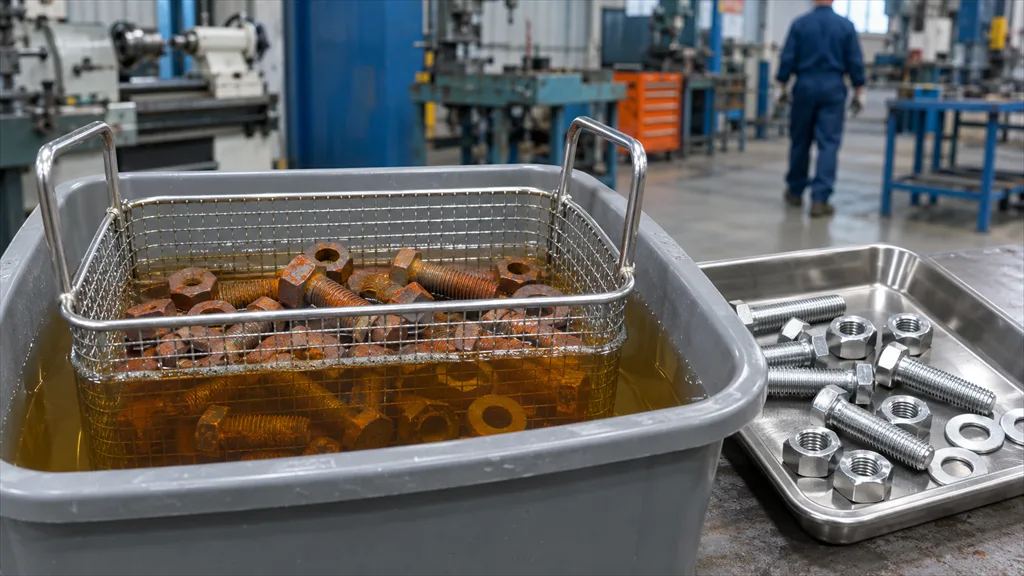
- By immersion, for small parts, fasteners or batches: the parts are immersed in the diluted product. With DESOXID L, the dilution ranges from 1:1 to 1:3 and the parts are kept immersed for 30 to 60 minutes (longer in stubborn cases); with DESOXID PH7, at 1:10 for the same time.
- With a brush, cloth or sprayer, for localised areas or large parts: the product is applied undiluted, the area is soaked thoroughly and the product is left to act.
In both cases, the rust comes off without heavy scrubbing. If any residue remains after the contact time, repeat the application on that area rather than greatly extending the contact time: an acid left on for too long can end up attacking the metal.
5. Rinse with water and dry immediately
When you have finished, rinse the part with plenty of water to remove the product and any dissolved rust residue, and dry it immediately with compressed air or a clean cloth. Freshly derusted metal is bare and, if it stays wet, it can rust again within a few hours.
6. Protect the surface
The final step is the one that stops the work from going to waste. Depending on how the part will be used:
- Machined parts or tools that are going to be stored or transported: a protective anti-rust oil such as PROTEX L or, in aerosol form, PROTEX L SPRAY, which repels water and is removed with solvent when the part is going to be used.
- Steel exposed to the weather (structures, railings, tanks, welds): a cold galvanising product such as GALVA ZINC BRILL SPRAY, with 95% zinc in the dry film, or a primer and paint.
- Moving mechanisms: a penetrating oil with lubricant and anti-rust additives such as FLODUR SPRAY.
Which rust remover to choose for each part
At CH Química we manufacture several rust removers because not all parts are treated the same way. This table summarises which one to use in each case:
| If you have… | Product | Why |
|---|---|---|
| Parts you do not want to expose to an acid, or parts made of several metals (iron, steel, aluminium, brass, copper, bronze) | DESOXID PH7 | Neutral pH, works at room temperature, does not need neutralising and leaves a temporary protective layer |
| Heavy rust on iron, aluminium, brass, copper or bronze parts, in tanks or barrels | DESOXID L | Cleans, degreases, removes rust and passivates in a single operation |
| Welds and stainless steel parts with slag or discolouration | LIMSOLINOX L (liquid) or LIMSOLINOX PG (gel) | Pickle and passivate stainless steel; not for use on carbon steel |
| Stainless steel and other metals that need to be homogenised and passivated, or lorry bodies and trailers | PASINOX | Degreases, removes rust and leaves the surface clean and bright |
| Screws, nuts and mechanisms seized by rust | FLODUR or FLODUR SPRAY | Penetrates, removes rust, frees and lubricates |
| Rusted mechanisms in the food industry | FLODUR NSF SPRAY | Penetrating oil and rust remover with food-grade registration |
| Parts that are already clean and need protecting during storage or transport | PROTEX L or PROTEX L SPRAY | Anti-rust oil that repels water and moisture |
You can see the full range in our rust removers and strippers category.
How to remove rust from stainless steel
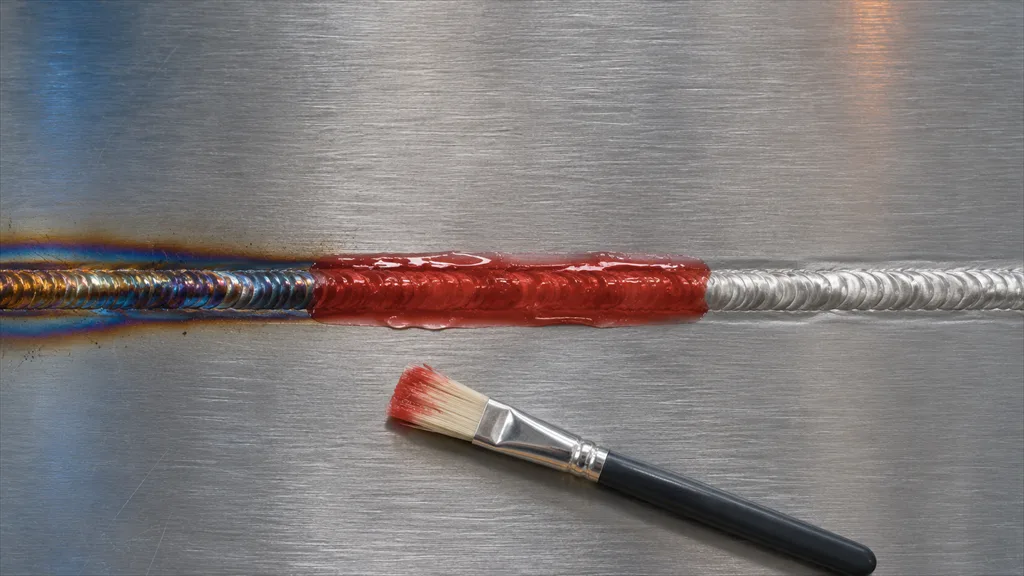
Stainless steel can also show rust stains. It is almost never the stainless steel itself that rusts: it is usually iron from other parts that has been left on the surface (filings, angle grinder sparks, carbon steel tools) or the area around a weld, where the heat alters the passive layer that protects the metal and leaves discolouration and slag.
In these cases, there are three things to bear in mind:
- Do not use carbon steel brushes or steel wool: they leave embedded iron particles that rust within a few days. Use stainless steel brushes or iron-free abrasives.
- Use a stainless steel pickling product: LIMSOLINOX L by immersion or spraying, or LIMSOLINOX PG, a gel that clings to weld beads even on vertical surfaces. They are only applied to stainless steel (AISI 304, 316 and similar).
- Rinse thoroughly and leave the surface passivated: these products clean the weld and passivate the metal, which is what restores the stainless steel’s corrosion resistance.
How to stop rust coming back
Once clean, the part is once again exposed to the same environment that made it rust. These measures make the result last much longer:
- Always dry parts after washing them, derusting them or machining them with cutting fluid.
- Protect bare metal the same day: anti-rust oil, cold galvanising or paint.
- Store tools and parts in a dry, ventilated place, away from acidic products and condensation.
- Check idle machinery and areas where water collects from time to time.
These routines are part of preventive chemical maintenance, which extends the service life of industrial equipment.
Frequently asked questions about how to remove rust from metal
What is the best way to remove rust from metal?
It depends on the condition of the part. For surface rust and parts with complex shapes, a chemical rust remover is the quickest and most effective option. For thick crusts, the best approach is to remove the loose material first with a brush and finish with the rust remover. In both cases, the part must then be rinsed, dried and protected.
Does vinegar remove rust from metal?
Yes, on small stains and given time, because it is a weak acid. But it does not degrease or protect, it takes hours and it leaves the metal bare, so the rust soon comes back. For professional use, a formulated rust remover is a better choice.
How long should a rust remover be left to act?
This is stated on each product’s technical data sheet. As a guide, DESOXID L and DESOXID PH7 work in 30 to 60 minutes by immersion, and on heavily adhered rust the time may be longer. With a penetrating oil such as FLODUR, you only need to wait a few seconds before freeing the part.
Can you paint over rust?
It is not recommended. Rust is porous, retains moisture and keeps advancing under the paint, which eventually lifts off. The correct approach is to remove it, dry the surface thoroughly and apply a primer before painting, or to protect the steel with cold galvanising.
Can a rust remover damage metal?
Not if it is used at the dilution and for the time stated on its data sheet. Acid rust removers can attack the metal if contact goes on too long, and stainless steel pickling products must not come into contact with carbon steel. If you want more margin for error, a neutral pH rust remover such as DESOXID PH7 works without the need for neutralising.
What is the difference between a rust remover and a penetrating oil?
A rust remover is designed to remove rust from a surface and leave it clean. A penetrating oil is a penetrant with rust-removing and lubricating action, used to free seized screws, nuts and mechanisms and leave them protected.
Industrial rust removers with technical advice
At CH Química we manufacture rust removers, strippers, penetrating oils and anti-rust protectors in Castellar del Vallès (Barcelona), with more than 30 years of experience in chemical products for workshops, industrial maintenance, boilermaking and the automotive sector. If you are not sure which product your part or process needs, contact our technical team and we will help you choose, providing its technical data sheet and safety data sheet.