
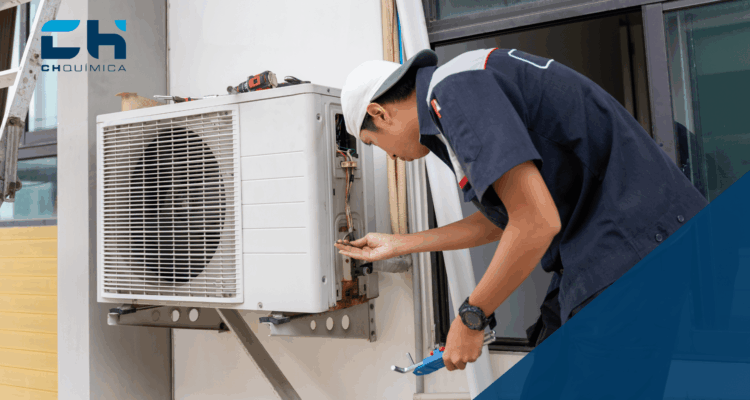
Industrial HVAC systems play a critical role in factories, logistics warehouses, corporate buildings, shopping centres and technical facilities. Their correct operation not only ensures thermal comfort but also directly affects energy efficiency, operational continuity and equipment service life. However, with continued use, these systems are exposed to the build-up of residues, dirt and moisture which, if not properly managed, can lead to recurring breakdowns, loss of performance and bad odours.
In this context, industrial HVAC maintenance ceases to be a one-off task and becomes an indispensable technical strategy. This article looks at how proper treatment of HVAC circuits can prevent incidents, optimise installation performance and reduce operating costs, focusing on air-conditioning system cleaning from a preventive and functional perspective.
The importance of industrial HVAC maintenance in demanding environments
Unlike domestic systems, industrial HVAC units run for long hours, with high air flows and in environments where the particle load is high. Airborne dust, residues from production processes and variable humidity conditions encourage the gradual build-up of dirt in ducts, coils, exchangers and indoor units.
When this build-up is not controlled, problems appear such as:
- Reduced air flow and heat exchange.
- Higher energy consumption to maintain the same temperature.
- Overstrain on fans and compressors.
- Unexpected technical stoppages and higher maintenance costs.
- Unpleasant odours caused by stagnant residues and moisture.
A well-defined industrial HVAC maintenance programme makes it possible to anticipate these problems and ensure stable, efficient operation of the installation.
How efficiency losses arise in HVAC systems
Residue build-up in key components
Air-conditioning systems include many elements that are sensitive to dirt: exchange coils, condensate trays, ducts and filters. The gradual accumulation of particles acts as a physical barrier that hinders airflow and reduces heat exchange capacity.
This forces the system to work at higher power, increasing energy consumption and accelerating wear on mechanical components.
Poorly managed moisture and condensation
Condensation is a phenomenon inherent to the operation of HVAC equipment. If it is not managed properly, the retained moisture encourages dirt to adhere and deposits to form, which affect system performance and produce unpleasant odours in the supply air.
Air-conditioning system cleaning: a key technical action
Air-conditioning system cleaning should not be seen as a one-off action but as part of a continuous maintenance strategy. From a technical point of view, its main objective is to restore the optimal operating conditions of the equipment by removing build-up that affects performance.
The direct benefits of proper technical cleaning include:
- Recovery of the original air flow.
- Improved thermal performance of coils and exchangers.
- Reduced energy consumption.
- Less premature wear on fans and motors.
- Prevention of odours associated with accumulated residues.
It is important that these tasks are carried out with products formulated specifically for HVAC circuits, compatible with the system materials and designed to act on dirt without causing corrosion or damage to components.
Preventing breakdowns through preventive maintenance
One of the main goals of industrial HVAC maintenance is to avoid breakdowns before they happen. The most common incidents (blocked drains, fan failures, loss of thermal performance) usually stem from a lack of cleaning and monitoring of the internal condition of the system.
A preventive approach makes it possible to:
- Detect abnormal build-up of residues.
- Correct operating imbalances before they lead to serious failures.
- Reduce the number of corrective interventions and unplanned stoppages.
- Extend equipment life and protect the investment made.
From an economic point of view, preventive maintenance is clearly more cost-effective than repairing breakdowns after they have occurred.
Bad odours in HVAC systems: a symptom, not the problem
In industrial environments, bad odours associated with air conditioning are usually the result of accumulated residues and retained moisture at certain points in the system. This is not an aesthetic problem but an indicator that the circuit is not working in optimal condition.
Addressing this problem requires:
- Identifying the points where dirt accumulates.
- Carrying out regular technical cleaning of the affected components.
- Improving condensation and drainage management.
- Establishing maintenance routines that prevent the problem from recurring.
From this perspective, odour control is part of the functional maintenance of the system, aimed at ensuring its correct performance over the long term.
Energy optimisation and operational sustainability
Energy efficiency is one of the main priorities in the management of industrial HVAC installations. A clean, well-maintained system requires less energy to deliver the same thermal performance, which translates into:
- Direct reduction in electricity consumption.
- Lower energy footprint of the installation.
- Fulfilment of internal sustainability targets.
- Improvement of operational efficiency indicators.
In addition, proper cleaning and maintenance reduce the need for premature equipment replacement, contributing to more responsible resource management.
Climate Line: technical solutions for HVAC maintenance
In this context, the Climate Line category from CH Química brings together chemical solutions designed to support the technical maintenance of industrial HVAC systems. These products are formulated to act on dirt accumulated in the circuits, make it easier to clean internal components and help preserve the original performance of the equipment.
Their application is part of technical protocols aimed at:
- Keeping systems in optimal operating condition.
- Reducing incidents caused by the build-up of residues.
- Improving the overall energy efficiency of the installation.
Always with a professional approach, compatible with the system’s materials and aligned with the real needs of industrial maintenance.
Keys to efficient management of HVAC systems
The treatment and maintenance of industrial HVAC circuits is a decisive factor in preventing breakdowns, minimising efficiency losses and controlling the appearance of bad odours. Opting for preventive industrial HVAC maintenance, supported by the technical cleaning of air-conditioning systems, improves performance, reduces costs and ensures the operational continuity of installations.
Integrating these practices into the routine management of installations not only protects the equipment, but also contributes to more efficient, sustainable and reliable operation over the long term. Contact the CH Química team for advice.